The life of Jonas Craven is very much linked with the textile firm, Craven and Harrop, which he founded, together with Henry Harrop and Henry’s son, William, until the firm passed to Francis Craven, Jonas’s second son, in August 1858. Added to the biographies will be that of Henry Harrop, (later in 2024).
Jonas was born 7 May 1793, at Black Carr, Thornton, and baptized at Kipping Chapel 11 August 1793, a son of Joseph Craven (1767-1842), who had married Mary Ann Walker, (1756-1853).
His obituary in the Bradford Observer of 6 September 1877 states of him, “As one of the staunchest Nonconformists in this district, and as a Liberal of the most pronounced type, he dearly prized civil and religious liberty and his means were ever forthcoming for any movement having for its object its perpetuation and extension…Above his fidelity to creed or party, however, he was pre-eminently a kind-hearted citizen.” And that is reflected in many newspaper articles throughout his life.
1817, March 17. Jonas married Deborah Drake.
In the 1820s Jonas had built in Kipping Lane a 3 storey warehouse, which still remains. Originally Rose Cottage’s building was attached to the warehouse. The warehouse was built, according to his grandson, Frederick Craven, to take in warp and weft, which Jonas gave out to hand-loom weavers.

The aforementioned obituary states that “Mr. Craven had witnessed the growth of the trade from its most primitive stages, and from the humblest beginnings had in his own active pursuit of it reaped the just reward of persevering industry and enterprise.” He commenced business in 1824 with Henry and William Harrop, in a partnership known as Craven and Harrop. “As Worsted manufacturers the firm had been the first in the district to introduce cotton warps, and they were also the first to manufacture Orleans and Coburgs. Previous to that nothing but woolen warps prevailed, and bombazines, plainbacks, etc., formed the staple trade.” “Of some indication of the extent to which the firm were engaged, it may be stated that from 1836 to 1844 they employed a thousand hand-loom workers, throughout a district embracing places as far away as Haworth and Stanbury.”
1837, April 15. The Bradford Review carried an advertisement about a meeting to petition Parliament about the Abolition of Church Rates. It carried the names of about a hundred supporters, mainly business men, including Joshua Craven, the founder of Prospect Mill, and both Jonas Craven and Henry Harrop, in business together in textile manufacture. (Church rates were not abolished until 1868). Kipping Chapel, which was a non-conformist independent chapel, attracted worshippers not just from Thornton, but also further afield. Nonconformists objected to supporting the established church, the Church of England.
1837, May 18. The Bradford Observer reported that Deborah, the wife of Jonas Craven, stuff manufacturer, had died at the age of 39. 6 of their children, 3 boys and 3 girls had lived to maturity.
1839 Jonas married Mary Smith, the daughter of Richard Smith, of Sutton in Craven, Yorkshire.
1840, January 1. The Bradford Observer reported that at a Vestry meeting the following people had been chosen as constables for the following year: Chief, Mr. M. Pearson; deputies: Messrs. J. Hardaker, J. Foster, J. Ambler, and Jonas Craven.
1841, June 6. The 1841 Census shows that Jonas and family lived in Kipping Lane. The 1841 census only gave road names. The family comprised of Jonas Craven aged 45 (which is wrong, as he was aged 48), Mary aged 35, Joseph aged 15, Francis aged 13, Edwin aged 5, Sarah aged 10, and Jane aged 5, and Betty Robins, who was described as a Family Servant, and who was born in Prescott in Lancashire. Jonas was described as a Manufacturer.
1842, February 1. The Partnership between Jonas Craven, Henry Harrop, and William Harrop, worsted stuff manufacturers was dissolved as regards as William Harrop.
1843, April 1. The Halifax Guardian reported that at a vestry meeting Jonas Craven, manufacturer, and Joseph Wheatley had been elected as Overseers of the Poor, and Joshua Craven, manufacturer, as Surveyor.
1843, September 2. The Halifax Guardian reported that Craven and Harrop, manufacturers of Thornton, had increased the wages of their handloom weavers, a piece 6d. on some sorts and 3d. on others. That increase led to Mr. John Tempest, manufacturer at Clayton, increasing a piece by 3d. The Halifax Guardian commented: “We are heartily glad of these indications of improvement in trade, especially on account of the long-depressed condition of this over-wrought and under-paid of this class of workmen who have borne their privations with a patience which alone renders them worthy of better things.”
1843, December 28. The Bradford Observer reported that Craven and Harrop had given £20 to the Great League fund, in a national demonstration in favour of Free Trade.
1844, January 4. The Bradford Observer reports that Mr. Jonas Craven of Thornton, on New Year’s Day, took his workpeople employed in Cannon Mill to tea together at the house of Mr. Walton, the Queens Arms Inn, Manchester Road. It continues “The charity and hospitality of Mr. Craven towards his workpeople, at all times, deserves to be made known; for if his kindness were imitated by other employers, the best feelings of our nature, would be in constant exercise between masters and men.”
“In 1844* Craven and Harrop built Dole Mill, Thornton, and from that period hand-loom labour gradually ceased and power-looms increased. At Dole Mill the firm employed on average 500 weavers, and ran also Waterloo and Prospect Mills, Bradford, altogether running over a thousand looms. In taking the principal management of this (for that period) large manufacturing establishment, Mr. Craven displayed much energy and business aptitude, and was the means of adding considerably to the prosperity of his fellow villagers.” (from Jonas Craven’s obituary in the Bradford Observer 6 September 1877.) * A newspaper report of January 2nd 1847, says the mill was built “last year”. Given that the report is only just in 1847, I suspect “last year” was the year before 1846, which was 1845, not 1844. Dole is the name of the field which the mill was built on. Doles are meadows in which several people had shares, for example within a common field. The Dole fields ran downhill from Market Street to the beck.
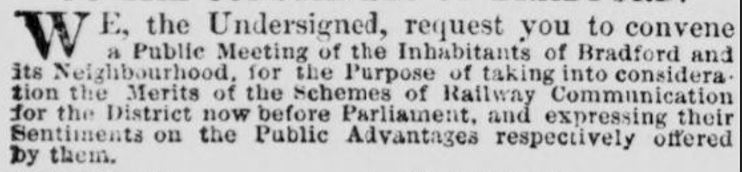
1845, February 8. The Leeds Mercury reported that Craven and Harrop were one of the signatories petitioning the Constables of Bradford, see the illustration about the Petition:
Note: © Copyright. All images of extracts from the British Newspaper Archive, via Find My Past are the copyright of both organisations. The photograph of the warehouse on Kipping Lane was taken by the author of this website and is free of copyright.
Textile companies supported all schemes for new railways through Bradford, which would widen markets for their goods.
1845, March 27. The Bradford Observer reported that Mr. Jonas Craven and Mr. Jonas Pearson has been elected Overseers of the Poor for the ensuing year.
1845, August 28. The Bradford Observer reported that “as Mr. Jonas Craven, was on his way, in a phaeton, from Harrogate, last evening, accompanied by Mrs. Craven, the horse suddenly took fright in descending, (as we understand), Humphrey Bank, about two miles from Harrogate; and as the animal dashed off, Mr. and Mrs. Craven were precipitated on the ground and severely injured. We have not been able to learn any particulars beyond the simple fact, save that Mr. Craven had his collar bone fractured, that the phaeton was smashed to pieces, and that the sufferers were subsequently removed to Harrogate, where they are now lying.”
1846, March 2. Craven and Harrop donated £100 to a campaign against the Corn Laws. Craven and Harrop were on the organizing committee,
1846, July 18. The Leeds Times carried an advertisement for a Public Dinner to Celebrate the Repeal of the Corn Laws, at the Oddfellows Hall, on Thornton Road in Bradford.
1847, January 2. The Leeds Mercury reported that the village of Thornton seemed to be emulating the neighbouring villages in its erection of mills, etc. Last year Messrs. Craven and Harrop erected a large one, capable of employment to 600 hands. (see note of 1844)
1847, January 28. Craven and Harrop were listed in an advertisement in the Bradford Observer as donors of £15 to the committee led by W. E. Forster for funds to relieve some of the suffering due to the Famine in Ireland, and in the Highlands and Islands of Scotland.
1848, February 26. Messrs. Jonas Craven and Jonas Pearson were re-elected Overseers of the Poor.
1848, October 10. A report in the Leeds Intelligencer that Mr. Jonas Craven, stuff manufacturer, had been sworn of the Grand Jury at the Morley Quarter Sessions.
1849, January 25. The Bradford Observer carried an advertisement concerning a petition as follows, to which Craven and Harrop were one of the signatories:
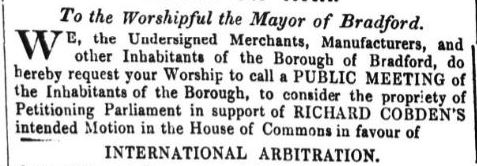
Wikipaedia tells us that “In 1849,” Cobden “brought forward a proposal in parliament in favour of international arbitration, and, in 1851, a motion for mutual reduction of armaments. He was not successful in either case, nor did he expect to be.”
1849, August 23. The Bradford Observer reported that Craven and Harrop had increased their subscription to the Bradford Infirmary from £3 8s to 5 guineas, (£5 5s.)
1849, September 6. The Bradford Observer reported that it had reported on a Factory Excursion paid for by “our esteemed mayor” Titus Salt, Esq., and that other factories had also had excursions. Others had decided, in place of an excursion, to give money, leaving their hands at liberty to enjoy themselves at their pleasure, and that Craven and Harrop had done that.
1849, November 17. The Leeds Intelligencer reported that Craven and Harrop had donated £2 2s. to the Yorkshire Union of Mechanics Institutes.
1849, December 20. The Bradford Observer reported that “on Tuesday last, at Shipley, by the Rev. W. Kelly, B. A., had married Joseph Jowett, spinner, of Bradford, to Sarah, second daughter of Jonas Craven, Esq., of Thornton.”
1850, December 12. An advertisement in the Bradford Observer read “To be let, and may be entered upon immediately, the Counting House, lately in the occupation of Heymann Alexander, in Charles Street. Also a larger Cellar underneath the above Counting House. Applications to be made to Messrs. Craven and Harrop, Charles Street.”
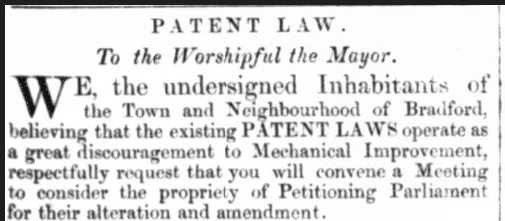
1851, January 30. Craven and Harrop were among the signatories of a Petition:
1851, March 27. Craven and Harrop advertised in the Bradford Observer, as follows: “Two rooms, suitable for Piece Rooms. Apply to Craven and Harrop, Charles Street.”
1851, March 30. 1851 Census shows at Rose Cottage, Kipping Lane, Jonas Craven aged 59, a “Merchant Worsted Manufacturer, 1 Firm, 2 Employers, 1363 Men Women.”, Mary his wife aged 46, Mary their daughter aged 21, Joseph aged 27, Edwin aged 18, (both sons being Merchant Manufacturers), Jane aged 16, plus Mary Cowling of Prescott, Lancashire aged 22 and Jane Speed of Pontefract, Yorkshire aged 18, both servants.
1851, May 10. The Leeds Times reported that Craven and Harrop’s stand at the Great Exhibition included “Coburg and Paramatta cloths; full-twill cloths; merino, Orleans and alpaca cloths. Moreens. Union and worsted damasks. Canton cloths; lining and serge cloths, etc.”
1851, October 25. The Illustrated London News carried a drawing of warehouses in Mosley Street, Manchester: –
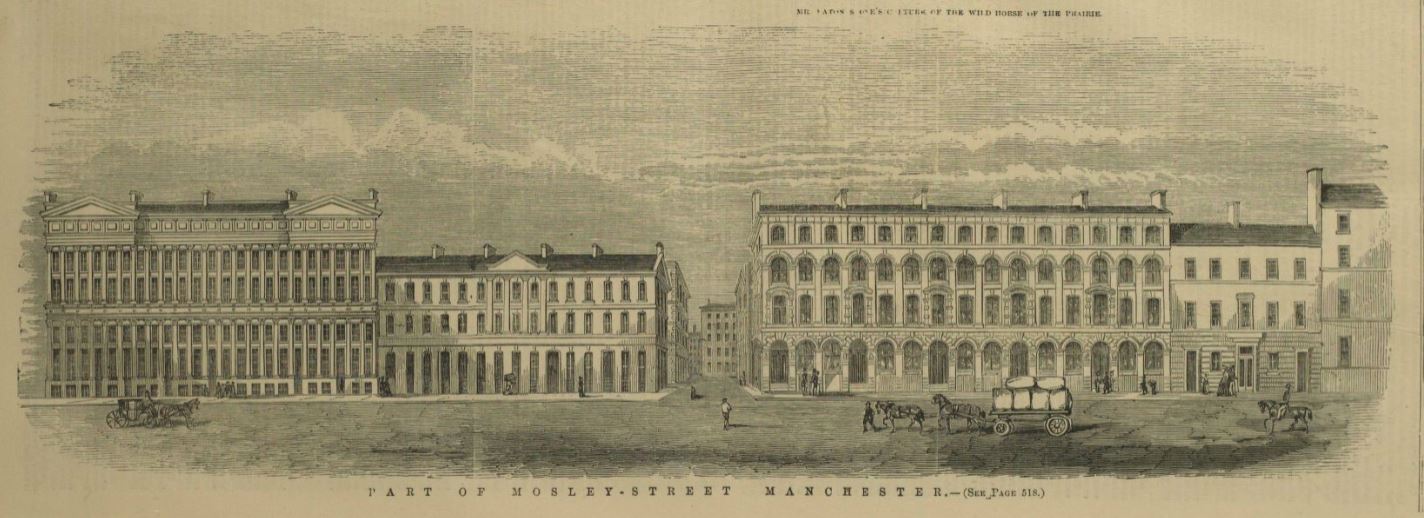
Plus a report “Among the principal warehouses in Mosley Street are those of … Craven and Harrop….” (I have not found any other reference to these warehouses).
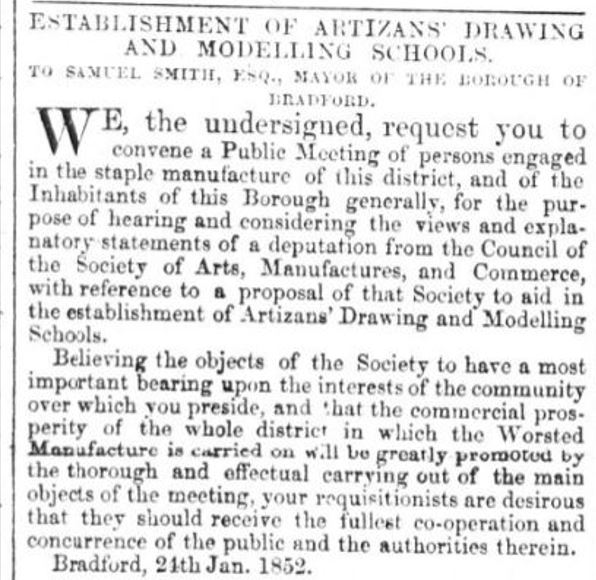
1852, January 29. Another petition, signed by Craven and Harrop, in the Bradford Observer, as in the illustration:
1852, August 19. The Bradford Observer reported on a treat given by Messrs. Craven and Harrop: “On Saturday afternoon, another of those social gatherings which ought to bind the interests of master and servant, in closer bonds, took place at Thornton. Messrs. Craven and Harrop, merchants and manufacturers, treated all their workpeople, employed in the manufacturing department here, amounting to upwards of 700, to tea; but “the cup that cheers but not inebriates” was accompanied with ample supplies of roast beef, ham, and other old English fare, and after full justice had been done to the edible department, the joyous company retired outside to enjoy sport and dance, not as in the days of yore on the ‘village green’, but the field adjoining the factory. A band of music added to other enjoyments; order prevailed throughout the proceedings, and after enjoying themselves for a considerable time, the numerous company separated highly delighted with the festivities of the day. – About a fortnight since, the employees in Messrs. Craven and Harrop warehouse at Bradford, had a similar treat, when they took tea, etc., in the Athæneum, Thornton, and then enjoyed cricket, etc., out of doors.”
1852, September 9. The Bradford Observer carried the following report: “WORKMEN’S FESTIVAL – In former numbers of our paper we have recorded entertainments given by Messrs. Craven and Harrop to their workpeople. On Saturday evening, the hands employed by this firm at Prospect Mill, Bowling, enjoyed a similar festival. An excellent and substantial tea was provided, to which all the workpeople were invited. After tea the evening was spent in pleasant intercourse; music, both vocal and instrumental, occupied a portion of the time, and there were recitations, songs, and other innocent pastimes. The presence of the principals was no check to the enjoyment, but added materially to the value of the entertainment. Would that such reunions were the rule rather than the exception!”
1853, May 30. It was reported in Saunders Newsletter (Dublin), that at the Great Exhibition in Dublin, “In one of the departments adjoining the Great Centre Hall, a conspicuous position has been allotted to the eminent manufacturers, Messrs. Craven and Harrop, Bradford, Yorkshire, in which they have a magnificent display of stuff goods, consisting of damasks in silk and worsted, cotton and worsted, and worsted, alike remarkable for the beauty of the designs and the excellence of the texture. There are also among the collection some very handsome damask table covers, and a quantity of the raw material in its various processes before manufactured into these fabrics. The contributions of this firm are well worthy of inspection.”
1853, June 2. The Bradford Observer reported further on the Dublin exhibition, giving an extract from the Art Journal of that month, “Messrs. Craven and Harrop of Bradford contribute largely their productions in mixed linen and wool – in extensive use for curtains, table covers, and other purposes to which this article is applied. The fabric is excellent and is manufactured by greatly improved processes peculiarly their own. The designs are all of considerable merit; in the whole collection, indeed, there is not one decidedly bad.” Engravings are given of two patterns, one of shells and sea-weed, and another of the vine and its fruit, both tastefully arranged.”
1853, August 4. It was reported in the Bradford Observer that a cricket “match was played on Saturday last, on the Victoria ground, between eleven of the men in the employ of Messrs. Craven and Harrop, and eleven of the men in the employ of Messrs., A. S. McLaurin and Co., when the former were victorious by fifty-five runs. The following is the score: Craven & Harrop, 1st innings 62; 2nd ditto 73. McLaurin’s 1st innings 45, 2nd ditto, 35.”
1853, August 27. The Leeds Intelligencer reported on a friendly game of cricket being played between XIs from Messrs. Craven and Harrop, and from Messrs. John Haigh and co., held in Peel Park, Bradford. Craven and Harrop won by 9 wickets.
1853, September 1. Another game of cricket was played on the Victoria ground between XIs from Craven and Harrop and Messrs. John Milligan, son and co. Again Craven and Harrop were victorious, in a 2 innings each side match, winning by an innings and 22 runs.
1853, October 31. Craven and Harrop donated £50 to the jubilee of the Bible Society.
1853, November 5. The People’s Paper reported that Messrs. Craven and Harrop of Thornton, had reduced their weavers about ten per cent, last week.
1854, January 12. An advertisement from Craven and Harrop., in the Bradford Observer read: “Rooms to Let, suitable to Manufacturers or others, Apply to Craven and Harrop.”
1854, February 16. In the Bradford Observer there was a report of a meeting of the Bradford Auxiliary of the Evangelical Continental Society. The income for the year had been £110 19s 11d, of which Craven and Harrop had contributed £50.
1854, April 8
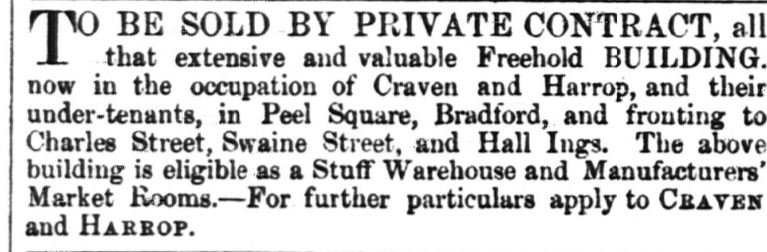
1854, September 9. The Leeds Intelligencer reported on the Testimonial to Lieutenant Perry commenting that the subscription already included, amongst others, £5 from Craven and Harrop.
1855, July 26. The Bradford Observer tells us about a massive storm at Thornton which caused the beck to overflow, aided by a collapsed reservoir, which destroyed walls, bridges, and other things of that kind, and destroyed fields of wheat, potatoes and the whole produce of several large gardens, but thankfully there was no loss of life. Considerable damage has been done to property belonging to Messrs. W. and H. Foster of Denholme, Mr Abraham Bairstow of Denholme Cough, Messrs. Townend and Wood, Mr. Abraham Ackroyd, Mr. Jonas Craven, and Messrs. Joshua Craven and Son. At Green Lane beck the tenants of the cottages and gardens belonging to Mr. Edward Townend are great sufferers, the flood having rushed into the houses, besides entirely destroying all in their valuable gardens. Many people were unable to return to their cottages until the following day….
1855, September 13. The Fall of Sebastopol. Led to the flying of flags in the town centre. Hundreds of flags have been displayed. Streets thickly crowded with flags, some of them very costly and beautiful objects. None could go through our streets without feeling satisfied that nearly every heart has exulted in the triumph which has just been achieved. Flags were also seen in the outskirts. Mills, warehouses, dyehouses. foundries, shops, and private houses vied with each other in the triumphal manifestation. Included Craven and Harrop’s and many other warehouses, all listed by name.
1855, October 4. The Bradford Observer carried a short advert: “TO BE LET TWO PIECE ROOMS situate in Hall Ings. Apply to Mr. D. Brear at Messrs. Craven and Harrop’s, Charles Street”.
1856, April 10. The Bradford Observer reported that Jonas Craven, to celebrate the return of Peace, (in Crimea), “treated about sixty old women to tea in the Kipping School, and presented them with a shilling each, after their social enjoyment.“
1856, May 15. The Leeds Mercury reported of great peace celebrations in Bradford. Textile warehouses in Bradford were decorated with flags, that of Craven and Harrop’s in Charles Street. “an ornamented flag, quartered with the ensigns of England, France, Turkey and Sardinia.“
1857, January 24. It was reported in many papers that a fire had broken out at 5.45am in the upper storey of Craven and Harrop’s warehouse in Bradford. Fortunately the Bradford Fire Brigade were returning to their base after a false alarm. Only a few yards of goods were destroyed. It only took half an hour to extinguish the fire. Subsequently shops in Cork and Shropshire had sales of damaged goods from the fire – the firemen having thrown them in the yard. The cause of the fire had not been found.
1857, May 7. The Bradford Observer reported: “AGREEABLE REUNION – Yesterday evening, the clerks and warehousemen in the employ of Messrs Craven and Harrop. and the workmen in the employ of Mr. C. Rhodes, painter etc., sat down to a sumptuous dinner at the house of Mrs. Hick, the George and Dragon Inn, Apperley Bridge; the entertainment being liberally provided by Messrs Craven and Harrop as an expression of satisfaction and good-will on their part at the termination of the labours of Mr. C Rhodes in painting and decorating the interior of their extensive warehouse in Hall Ings. The evening was spent harmoniously.”
1857, August 13. The Bradford Observer reported that on Saturday Messrs. Craven and Harrop gave a treat to all their workpeople, at both Thornton and Bradford. A special train took them from Bradford to Blackpool on Saturday morning, ad they returned in the same way on Tuesday evening.
1857, September 1. The Leeds Mercury reported “BRADFORD, Monday. The state of our market remains about the same as Thursday last. There is no improvement in the demand for pieces, and raw materials, both wool and cotton, are still hardening in price. We understand that one of the large manufacturing firms of this district (that of Messrs. Craven and Harrop) have commenced running short time. Having made all the goods they require for the autumn trade, they will next have to prepare for the spring trade, but they are deterred from going on with their production at the usual rate owing to the present high price of the raw material.”
1858, January 12. The London Morning Herald reported that Messrs. Craven and Harrop, of Bradford, in business as stuff merchants and manufacturers, had called their creditors together for the purpose of obtaining time to meet their engagements…their accounts show a surplus of £40,000. In Leeds several other suspensions had occurred..
1858, January 14. The Sheffield Daily Telegraph reported under the heading of “FAILURES, Etc.” that a meeting of creditors of Messrs Craven and Harrop, stuff merchants and manufacturers had taken place in Bradford. The statement of affairs showed the liabilities to amount to £127,420, with assets estimated at £170,025 and it was agreed to accept payment in full with 5% interest in four instalments at 3, 6, 9, and 12 ,months.
1858, January 16. A report in the Leeds Times also added that Craven and Harrop would wind up their mercantile business and confine themselves, henceforth, to the manufacturing branch.
1858, March 25. the Bradford Observer reported on “ANOTHER MILL FIRE – THORNTON”, stating “On Saturday night, about nine o’clock, the inhabitants of Thornton were thrown into a state of great excitement by a report that Messrs. Craven and Harrop’s mill was on fire. In a few minutes hundreds of people were on the spot, and the unmistakeable evidence of fire in one of the top rooms was apparent. Messengers were forthwith despatched to Bradford and Queenshead, for the fire engines, and in a very short time two from the former place and one from the latter were on the spot. In the meantime, however, before the keys could arrive, an entrance was forced into the mill. Abundance of water being at hand, and plenty of willing hands to convey it, the fire was extinguished before it had obtained much hold. According to general opinion the fire was happily discovered soon after it broke out, for though the flames spread rapidly, and destroyed £300 or £400 of property within a very little while, yet it was confined to a limited portion of the building, and yielded to the active exertions of a few unprofessional firemen. The services of the fire engines were, consequently, not required. We are sorry to have to add, that there is no doubt that the fire originated in the wilful act of an incendiary. A cotton warp, which had been saturated in oil, had been placed across three jacquard looms, and then ignited. Every effort has been used to discover the guilty party but so far without success. … The external indications of the disaster are very slight, and on Tuesday the extensive works resumed their normal operations as though nothing of the kind related had happened.”
1858, April 22. The Bradford Observer carried the following advertisement:

1858, June 10. A larger advertisement in the Bradford Observer:
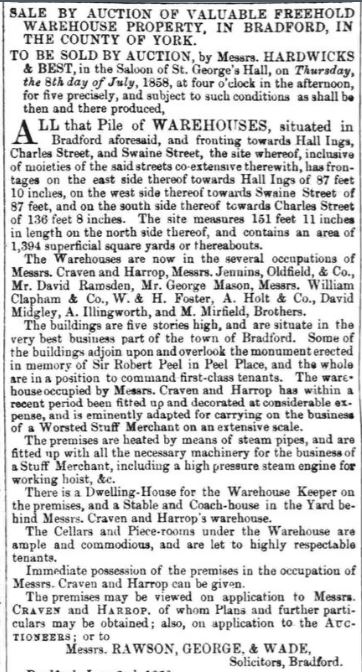
1858, July 19 The Leeds Intelligencer reported on the sale of the “Pile of Warehouses”. The bidding opened at £5,000 by Mr, Joshua Appleyard of Halifax and ended by Mr. W. Ripley offering £11,500. (The equivalent of £1.79 million today (2024).
1858, August 13. The London Gazette reported that the Partnership of Jonas Craven, Henry Harrop and Joseph, Edwin, and Francis Craven, stuff manufacturers had been dissolved, by mutual consent, on August 11.
The running and ownership of Dole Mill passed to Jonas Craven’s sons.
1858, August 14. The Bradford Review carried the following advertisement:

1858, September 16. Despite the dissolution, the Bradford Observer carried an advertisement stating that the Stuff Warehouse now in the occupation of Craven and Harrop, situated in Peel Square, Bradford is offered to Let, fitted with a hoist, engine, stabling, coach-house etc, and is adapted for carrying on an extensive stuff business, “or may be divided to suit tenants.”
1858, September 25. The Bradford Review carried the following advertisement. (I have been unable to find any report of this sale, and suspect it did not take place, or there were no buyers. Lot 1 turns up in another sale during Francis Craven’s tenure of the mill.)

1860, August 16. It was reported in the Leeds Times that the Rev. James Gregory, at Kipping Chapel married Mr. George Townend, son of Simeon Townend, to Jane, younger daughter of Mr. Jonas Craven.
1861, March 21. It was reported in the Bradford Observer that Sarah, the wife of Henry Harrop, Esq., of Thornton, had died in her 69th year.
1861, April 7. The 1861 census for Rose Cottage, Kipping Lane, shows Jonas Craven, aged 67, as farming 20 acres employing 4 men, His wife, Mary aged 55, Sarah Roecroft, a servant aged 26 from Cundall, Yorkshire (it’s near Harrogate), and Elizabeth A. Pool described as a visitor, employed as a Milliner, born in Thornton. It also showed that in Ball Street, Henry Harrop a widower and a Gentleman, had a House servant, Hannah Robinson.
1861, August 31. It was reported that Henry Harrop, Esq., aged 73, late of the firm of Craven and Harrop, had died.
1863, March 12. The marriage of the then Prince of Wales to Princess Alexandria of Denmark, at St, George’s Chapel, Windsor, on March 10th, led to local celebrations. The Bradford Observer reported that Jonas Craven had treated upwards of 160 widows to a good tea in the Kipping Old School-room, and presented each of them a shilling besides. In the village of Thornton, “the mills and many private houses were decorated with flags, etc., and the Dole Mill was very prettily illuminated by F. Craven and Co. There was a splendid star in the Athæneum, in Commercial Street.”
1864, October 29. The Bradford Review reported on a forthcoming event: there had been on exhibition “in the shop windows of Mr. William Thomas, of a beautiful and valuable timepiece, which is about to be presented to Jonas Craven, Esq. It bears the following inscription: – ‘Presented to Jonas Craven, Esq., by a great number of the inhabitants of Thornton, as a grateful acknowledgement of supplying them with spring water for the last ten years. Oct. 31, 1864.’” The Bradford Review of 3rd and 5th of November 1864, then reported at length the details of this presentation. The report is given in full. The reporter must have been good at shorthand; Pitman’s shorthand first appeared in 1837.
WATER SUPPLY – PRESENTATION TO MR. JONAS CRAVEN. “The village of Thornton, standing on the declivity of a hill, its inhabitants have always had to suffer some inconveniences in obtaining a supply of good spring water. Some ten years ago , Jonas Craven, Esq., seeing this, and with a view to remedying the evil, was at considerable expense in conveying a supply of excellent water from the distant hills to his own residence, and, at the same time, he very kindly and considerately provided a tank, in order to accommodate his neighbours. This privilege they have enjoyed ever since; but it is only during the recent unprecedented drought, that they have been impressed with its value and importance. A few weeks ago, the idea occurred to a few friends that Mr. Craven’s kindness in this respect, ought to be acknowledged in some public and substantial form; and the matter being warmly and cordially taken up, a subscription was commenced, and was carried on to a most successful issue. On Monday night last, Mr. Craven was presented with a valuable and splendid timepiece at a tea meeting which took place in the Kipping School. … The number who took tea was upwards of 300….”
“The large company, after taking tea in three different parties, adjourned to the new school-room, where the most important and interesting proceedings were commenced.
“On the platform were the most influential gentlemen in Thornton, and upon Mr. Craven making his appearance in the midst of them, he was greeted with several rounds of enthusiastic cheers. The Timepiece which was intended to be presented, stood upon a table in front of the audience, and was much admired. it has been selected from the extensive stock of Mr. William Brooksbank, silver-smith, Market Street, Bradford and is a magnificent article, value 28 guineas. Its design is the nine Muses, with the goddess of music as its principal figure; it is in gilt and oxidised bronze, the base being of the finest finished African Onyx. It is constructed to go 15 days, and strike the hours and half hours, and is enclosed in a large glass shade. Upon a beautifully gilded plate, in front of the base is engraved the …inscription (as given above).
“Joseph Corrie, Esq., surgeon, having been elected chairman, introduced the proceedings in a few pertinent observations, expressive of the pleasure he felt in being present to take part in so interesting a ceremony as the presentation of a tribute of their excellent and esteemed friend and neighbour, Jonas Craven, Esq. They all knew that he had, at his own expense, been a blessing to the village in supplying them with water. He had also been very generous and kind in many other respects, nor were the people of Thornton indebted only to him, for during the last few months, when Mr. Jonas Craven’s supply of water became inadequate for the whole population, Messrs., Joshua Craven and Sons, with their accustomed liberality, threw open their gates for the accommodation of the public. Mr. Joseph Craven had also acted in a similar manner, and he thought that a meed of praise was due to them. The Chairman then called upon Mr. Jonathan Northrop to address the meeting.
“Mr. Jonathan Northrop “said he had no idea of being called upon first to speak, but this being a water question, and he being a teetotaller, he was ready to do so. (Cheers) Water was valuable, and the large company present that evening was proof of it. They all knew that Mr. Craven had supplied them with this element for domestic and other purposes now for ten years. They also knew that when the plan which Mr. Craven has carried out, was first projected, he (Mr. Craven) was anxious that the matter should be taken up by the town, but his generous offer was refused. Notwithstanding this refusal, however, Mr. Craven proceeded with his plan, and great blessings had been enjoyed by its inhabitants as a result of his kindness and his perseverance.. What they wanted in Thornton was a Board of Health under the Local Government Act. Fever had prevailed in the village, and deaths had taken place, even two in a house.” He, Mr. Northrop, then referred to Mr Craven’s humble origin, and to the success which had attended him in trade, until he became the principal manufacturer in the town. He (said Mr. Northrop) had paid tens of thousands of pounds in wages to the operatives, and the wages thus paid by him were equal to the wages of any other manufacturer in Bradford. When Mr. Craven gave up his business he did not give up his attentions to the welfare of his neighbours – for not only did he provide them with water, but he made it his business – and spent hundreds of hours – in superintending its delivery. With some men the most important question was how they could get money. they were careless altogether about anything else; but with Mr. Craven the inquiry had been – how can I most benefit my neighbour? (Applause). His benevolence and his liberality had been unbounded. He should like to see many more such men in Thornton. There was room for improvement in this respect. When men were getting money they were at the same time increasing their responsibility.” The speaker concluded an excellent speech in the midst of much applause.
“Mr Jonas Hartley next spoke. He said that he had never met his friend and neighbours on so pleasing and gratifying business as that which they had that evening to perform. Mr. Craven had made the offer of water for the benefit of the town; and it was a generous offer, but it was rejected. Notwithstanding, Mr. Craven had supplied them with the water, and what a blessing it had been last summer! What could they have done without it? That time-piece had not cost much, but Mr. Craven would not estimate it by what it had cost, but by the grateful feeling exhibited in its presentation. (Applause). Mr. Hartley then proceeded to speak of Mrs. Craven, in terms of eulogy and praise, and then turning to Mr. Craven, he said ‘I know, Sir, that you will think no worse of your wife for being kind and liberal to the poor.’ Mr. Hartley concluded by saying that if the clock would tell the time of the day, as well as Mr. and Mrs Craven had done their duty to the poor of Thornton, it would never stop.
The glee party gave “The Village Choristers” in their usual excellent style.
“The Chairman now introduce the Rev. J. Gregory, who said that he had but few observations to make; but they should be cordial. It had been said often, that the value of a thing was best known by the want of it. they all knew the value of water. The summer of 1864 had been a memorable one on account of the long drought they had had. The river, perhaps, had never run so low, streamlets had been completely dried up, wells and springs had been exhausted. this having been the condition of country districts, the want of water had been more severely felt in large towns. Mills had been brought to a stand. In Thornton they had felt this scarcity greatly. all the prdinary supplies had been dried up; and what could they have done if Mr. Craven had not opened a supply? But that was not all. Mr. Craven had given it to the public cheerfully; and althouhg some people had spoken lightlly of Mr. Craven’s kindness, that gentleman had not closed his door to them. he would remind them that they had been supplied with this beautiful water for a period of ten years; but this had been referred to by their friend, Mr. Northrop, and he need not go over the ground again. Now they all felt that something was due to Mr. Craven, not in the shape of payment, but as a testimonial of their united gratitude. He would say that it would be to the degradation of Thornton if something was not done to obtain a public supply of water. Why should they be behind other villages in this respect? Turning to Mr. Craven, the Rev. Gentleman then said: – ‘The pleasing duty now devolves to me, Sir of presenting to you this testimonial. It is given as an expression of our indebtedness to you for the supply of spring water you have given to us, during a period of ten years, and as a neighbour who has kindly considerations towards us; also as a link of affection and respect between us donors and you the recipient; and I hope it will be handed down by you to your children, and to your children’s children, and that it will be looked upon by them as a mark of respect to their father. I wish it had been more costly, but I know that you will estimate its value more by the motives which have influenced the givers than by the amount of money that it has cost, and I have no doubt that when you have taken this timepiece to your home it will often remind you how quickly time is carrying you and me, and all of us, to that home from which no traveller returns. Mr. Chairman, ladies and gentlemen, I have been exceedingly happy in having had the honour of presenting this testimonial. Mr. Gregory resumed his seat midst must cheering.
“Mr. Craven then presented himself and was vociferously cheered. After silence had been restored, he said:- “Mr. Chairman, ladies and gentlemen, I beg to tender you my unfeigned and most cordial thanks for this unexpected and unmerited token of your regard and esteem. I feel myself to be utterly unworthy of the distinguished honour you have this evening conferred upon me, and permit me to say that in giving you this supply I have done nothing more than my duty, and in the discharge of this duty I have experienced an amount of pleasure which has far more than compensated me for any little inconveniences which may have been given to me. Some people have said to me that I might have made money by the distribution of the water, but this I had no desire to do. I have no object to serve but to do good to my neighbours. In reference to this beautiful timepiece which I have just received at your hands, I have this fear, namely, that it will cause me to have to refurnish my room in order to make everything correspond therewith. (Laughter). Ladies and gentlemen, you are quite welcome to the continued use of this water, and allow me to say further, that when you are employed in fetching it away, let me beg of you to think of the great necessity that exists, and importance, that you should be as eager and as earnest after the water of life. I will say no more, only repeating my thanks to you all for this valuable present. (Cheers). Glee, “Here is cool grot“, was then sung after which:-
“Mr. T. S. Scarborough said he felt himself in a peculiar position in being called upon after such brilliant speeches had been made. He was, however, glad to be present on that occasion. He did not remember at any place seeing such emotion as he had witnessed that evening. He had watched the trickling tears which were expressive of deep gratitude; he had heard the rapturous applause, and this gave to him a feeling similar to theirs. He was sure that the donors of that handsome memorial felt grateful for the favours which they had received at the hands of Mr. Craven, and he felt equally sure that the recipient will be gratified to find his kindness was appreciated. He (Mr. Scarborough ) hoped that Mr. Craven might live long to behold it, and he felt sure that he would have pleasure looking at it during the whole of his life, and that when he died, he would leave a good name behind him, which time would not efface… He proceeded to shew that feelings of good-will and respect ought to be reciprocated between the employers and the employed, and those feelings should not be confined to this mill but extend into the village, the poor should be helped by the rich and the rich should be loved and respected by the poor. A village like Thornton had got hearts and hands, and all that was wanted was that they should be joined together and they would make each other happy. He hoped they would try to benefit those around them, and by so doing they would benefit themselves. He would say again that he had great pleasure in being amongst them that evening, and he had no doubt that they would all profit by their gathering and that they would all learn that happiness consisted not in the abundance that a man possessed, but in a virtuous and useful life. He wished to see all men so live and conduct themselves that when they left this world that they might leave a name that would be honoured and revered. He wanted to see men live for the public weal. Mr. Scarborough resumed his seat in the midst of long-continued applause.
“Addresses were given by Mr. Joseph Toothill, and Mr. William Thomas. The latter detailed at great length the numerous expressions of good will and respect towards Mr. and Mrs. Craven, which he had heard whilst soliciting subscriptions amongst the inhabitants of Thornton.
“Mr. Jonas Hartley volunteered a statement to the effect that every effort was being made to establish a board of health in Thornton. The matter was then in the hands of Sir George Grey, the Home Secretary.
“The Rev. Mr. Gregory now varied the proceedings by giving out the him (sic) “There is a land of pure delight” which was sung with much fervour and evident emotion.
“Mr. Phineas Craven, in obedience to a call of the Chairman, delivered a beautiful and appropriate address, at the conclusion of which he read some lines, which he said had been composed for that occasion by Mr. John Ackroyd, a resident of Thornton. the verses were of very pleasing character, and well expressed the feeling which seemed to actuate all present. (The Bradford Observer report states):- “We can only afford space for a portion of them, as a specimen.
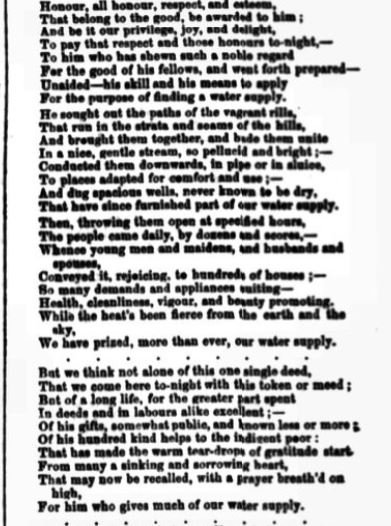
“Great cheering followed the reading of the verses. Then there was the Glee group singing “Come where my love lies dreaming”
“Votes of thanks were then awarded to the ladies for providing the tea, to Mr. John Ackroyd for his lines, to the Glee Party, and to the Chairman, and the interesting proceedings were brought to a lose, We may state that during the evening the massive gold medal, weighing twelve ounces, bearing suitable devices, which had been awarded to Mr. Joseph Craven (son of Jonas) by the Commissioners of the New South Wales International Exhibition of 1862 for his samples of shawls, was handed round the room. it was much admired and several of the speakers referred to it as a great honour which had been conferred upon Thornton.”
“Further details of that medal are given in the Leeds Times of November 5, 1864: “During the proceedings the massive gold medal received by Mr. Joseph Craven, of Dole Mill, from the Exhibition Commissioners of New South Wales, for examples of goods manufactured from wool grown in that colony, was handed about the room for inspection and was much admired.”
1865. November 16. The Bradford Observer carried the petition, as shown in the illustration, together with the names of hundreds of people who had signed it, including Jonas Craven.

1868, July 2. The Bradford Observer, under the headline of “A GENEROUS ACT” reported: “Some time ago, before the days of local boards, Mr. Jonas Craven, of Thornton, was at considerable cost in conveying a stream of water in pipes from a distance to his own house, and now that an unprecedent scarcity of water exists in the village, Mr. Craven throws open his taps at certain hours of the day, and allows the inhabitants generally free access to them. This is a boon which is highly appreciated.”
1869, August 6. Jonas’s niece Miss Eunice Bateman, married Mr. Robert Stuart of Edinburgh, Scotland by the Rev. W. M. Arthur at New Road Congregational Church.
1869, August 12. The Bradford Observer reported on the 17th annual exhibition of the Thornton Floral and Horticultural Society which had taken place in a field near the New Inn. The society was open to the inhabitants of Thornton, Allerton, Clayton, Wilsden and Denholme. Jonas Craven was one of the many patrons of the society… The exhibitors this year are all working people. Mr. Jonas Gawthrop had awarded to him a brass pan for the heaviest gooseberry, its weight being 20 pennyweights. (dwt). Several dishes of beautiful grapes were exhibited by Mr. Jonas Craven, but not for competition. A large number of prizes were distributed, a complete list of which were not available to the reporter. In the evenings of each day, in connection with the show, a gala was held in the field, when a great variety of rural sports and pastimes were introduced, the Thornton United Brass Band having been engaged for the occasions.
1871, April 2. The 1871 Census shows Jonas aged 77, shown as Retired Manufacturer, Mary his wife, aged 66, Frederick his grandson, aged 18, a clerk, and a servant / housekeeper Sarah Hartley, aged 41 from Haworth.
1872, January 26. In the By-election held in West Riding North Division, Jonas Craven, David Craven of Close Head, and Joshua Craven of Ashfield House, all declared that they would be supporting Isaac Holden, Esq., the candidate for the Liberal Party. Not only that but the Bradford Observer reported, on 30 January 11872, on a visit by Mr. Holden to Thornton: “Last night Mr. Holden addresses a large meeting in the Kipping School-room, Thornton. Mr. Francis Craven (Jonas’s son) presided, and was supported on the platform by Mr. Joshua Craven, senior, Mr. Joshua Craven, junior, Mr. David Craven, Mr. Joseph Craven (Ashfield), Mr. Jonas Craven, Mr. George Townend, the Rev. E. Salt, the Rev. F. Hall, Alderman Law, Mr. Angus Holden, Mr. Jonathan Northrop, Mr. Jonas Waterhouse, Mr. Midgeley Priestley, Mr. Thomas Bancroft, Mr. James Barraclough, Mr. Phineas Craven, and others.” Mr. Holden then went on to talk about the Conservative’s Reform Bill, free trade, and freedom of religion and education. Contrary to expectations the Conservative candidate won with a majority of 44 votes.
1873, June 10. The Bradford Observer reported on the death of Mr. Joseph Craven, (Jonas’s eldest son), “formerly of Craven and Harrop, manufacturers at Thornton and merchants at Charles Street….” (His obituary and funeral will be given under his biography at a later date, in 2024.)

1877, September 2nd, Jonas Craven died. In his obituary in the Bradford Observer (extracts of which were at the start of this biography) also states: “By the death of Mr. Jonas Craven, of Rose Cottage, Thornton, his native village has been deprived of one of the most honoured inhabitants. Mr. Craven was one of the last representatives of the old race of master-manufacturers who contributed in so great a degree to the development of the worsted trade in this district, and so far as Thornton valley is concerned, the class may be said to have become extinct by his decease. During his long life – extending over eighty four years – Mr. Craven had witnessed the growth of the trade from its most primitive stages, and from the humblest beginnings had in his own active pursuit of it reaped the just reward of persevering industry and enterprise….” and after the extract at the top of this page, ..”In 1844 the firm built Dole Mill, Thornton, and from that period hand-loom labour gradually ceased and power-looms increased. At Dole Mill the firm employed on average 500 weavers, and ran also Waterloo and Prospect Mills, Bradford, altogether running over a thousand looms. In taking the principal management of this (for that period) large manufacturing establishment, Mr Craven displayed much energy and business aptitude, and was the means of adding considerably to the prosperity of his fellow villagers. It is as a neighbour and a friend, however, that the deceased gentleman will be most missed in his native village. As a dalesman he was fond of Thornton and all that belonged to it. Latterly he never cared to leave it, except for occasional visits to inspect the growing wonders of Bradford and Leeds, in which latter town he took some interest, as it was there he sold his “pieces” long before there was a merchant established in Bradford. He was never what is known as a public man, in the sense of taking the lead in township affairs. as one of the staunchest Nonconformists in this district, and as a Liberal of the most pronounced type, he dearly prized cicl and religious liberty, and his means were ever forthcoming for any movement having for its object its perpetuation and extension. he had been a deacon at Kipping Chapel for many years, and upon its being rebuilt in 1845, he and his partner, Mr. Harrop contributed the sum of £1,000. On the erection of New Road Side Congregational Church , in 1866, he contributed largely to the building fund, and up to the last was the principal supporter of the new Nonconformist interest. In both places he actively identified himself with the Sunday school, and almost up to the day of his death his delight was in teaching young people. Above either his fidelity to creed or party, however, he was pre-eminently a kind-hearted citizen. His own mode of life was of the simplest and quietist, and that portion of his means not required to satisfy his modest wants he gave to others. it is said that for years he has given away two-thirds of his income. Mr. Craven was twice married, and had by his first wide a family of whom six children, three sons and three daughters, arrived at maturity. Mr. Joseph Craven, of Clapham, London, who died in June 1873, was his eldest son, and the two still living are Mr. Francis and Mr. Edwin Craven, also of London. His wide, to whom he had been married thirty-eight years, still survives him. Mr. Craven’s illness was of very short duration. He was in Bradford a week before his death, but succumbed to natural decay on Sunday morning last. (2nd September). His remains were yesterday deposited at Kipping Cemetery, Thornton, in the presence of a large concourse of his old neighbours and friends. Preceding the hearse were the representatives of the New Road Church and congregation, the Sunday school; the Thornton Local Board, headed by its chairman, Mr. Frederick Mossman; the School Board, and gentlemen of Thornton and other places. among the latter we noticed Mr. Henry Illingworth, Mr. Nathan Drake, Mr. Phineas Craven, Mr. John Glover, Mr. Thos. Baines, Mr. J. Waterhouse, Rev. J. Gregory (Leeds) Rev. Thomas Roberts (Bradford), Mr. Joseph Craven (Ashfield), Dr. Rawson, Mr. W. L. Bunting, Mr. Jonathan Northrop, Mr. R. J. Walton, Mr. Joseph Shackleton, etc. From Rose Cottage the corpse was taken to the New Road Church, where the burial service was read by the Rev. John Stevenson, the minister, and an appropriate prayer offered by the Rev. Thomas Davis, of Wellington, Salop. Upon the coffin a beautiful wreath, sent from Ashfield by Miss Craven, was deposited. The service at the Cemetery was also conducted by the Rev. J. Stevenson, who, it is announced, will preach a special sermon upon the event on Sunday morning week.”
1881, April 2. The 1881 Census shows Mary Craven, born in Sutton in Craven, a widow, aged 76, an annuitant living in Market Street, with a servant, Emma Moody, aged 21, originally of Lockerly in Hampshire.
1884, July 27 Mary, widow of Jonas Craven, aged 79, died at Croft House, Thornton.
(Inedexed in People, 13 August 2024)
 All About Thornton